 STRIVESOCK
When starting a sock brand, one of the easiest mistakes is assuming that a bigger first collection looks more professional.
You may think you need:
- five sock styles
- several colors
- multiple sizes
- different packaging
- different technical features
before customers will take the brand seriously.
But more products also mean:
- more sampling
- more inventory
- more photography
- more packaging
- more ecommerce pages
- more forecasting
- more money tied up in stock
For many new brands, a better first collection is much smaller.
A focused launch gives you something more valuable than variety: clear sales data.
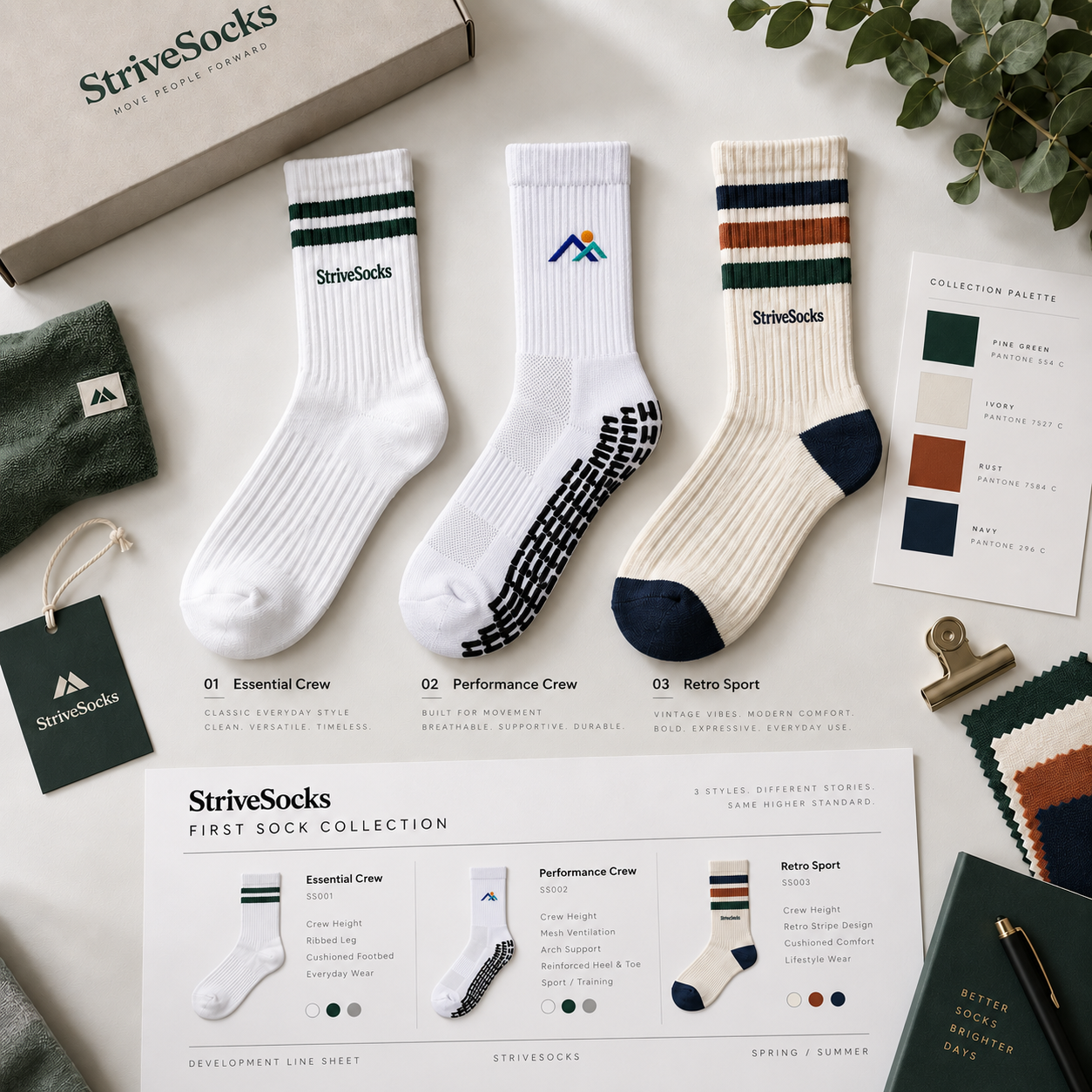
Quick Answer: How Many Sock Styles Should You Launch?
For many new sock brands, a practical first launch is:
1 to 3 core sock styles
rather than a large collection.
Very Focused Launch
1 style
Best when:
- budget is limited
- the brand has one clear use case
- the product itself is the main idea
Balanced First Collection
2-3 styles
Best when:
- you want customers to have some choice
- the styles serve different but related needs
- you can support the inventory
Larger Launch
4+ styles
Best when:
- demand is already validated
- the brand has an existing audience
- you understand your customer
- you have enough budget for stock and marketing
The right number is not based on how many products look good together. It should be based on how much useful inventory you can support per SKU.
Why More Styles Create More Risk
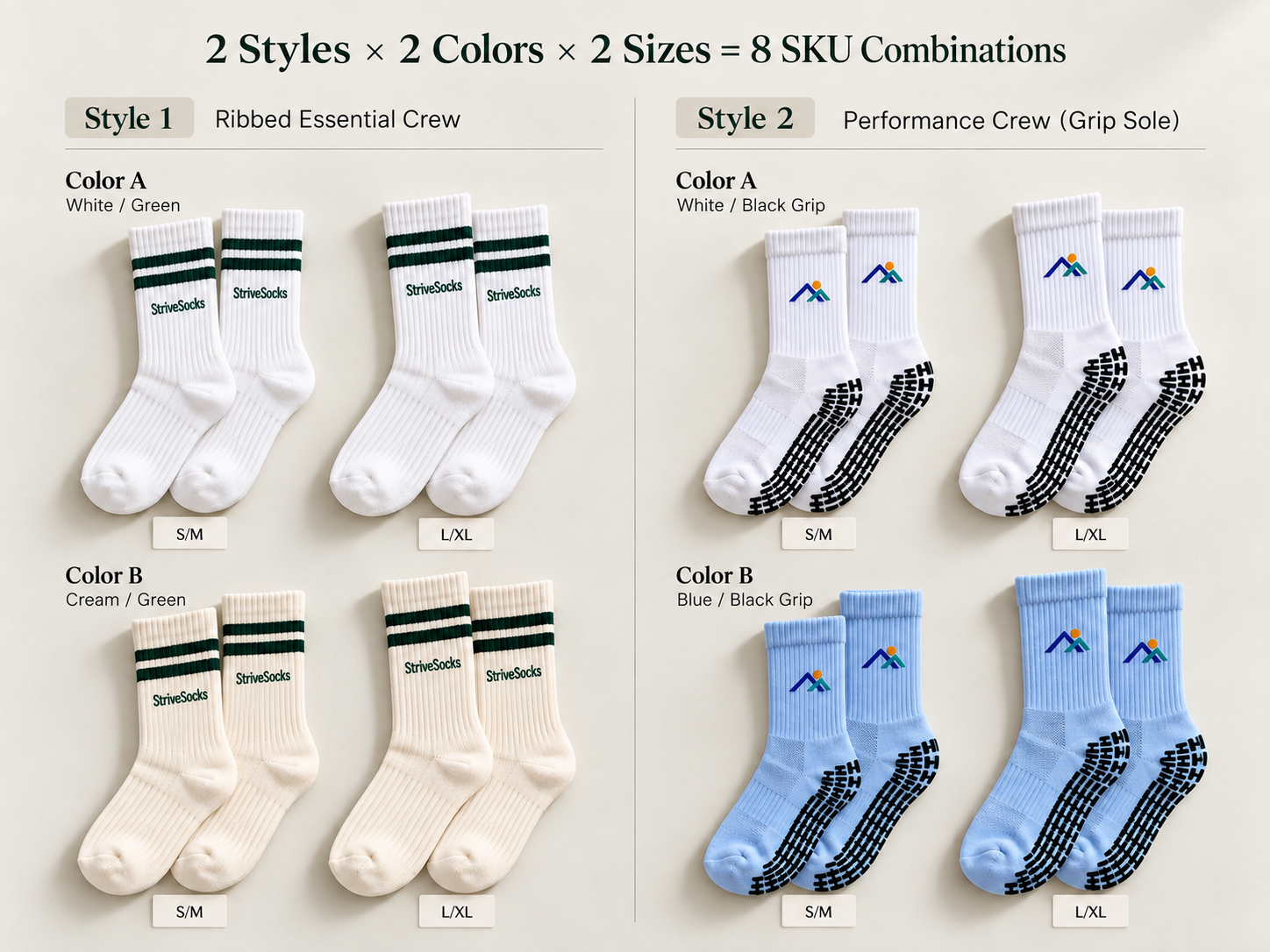
One style does not equal one SKU. Every style can multiply into:
Style × Color × Size = SKU count
For example:
Collection A
2 styles × 2 colors × 2 sizes = 8 SKUs
Collection B
5 styles × 4 colors × 3 sizes = 60 SKUs
That is a completely different inventory problem. Even if the total order quantity looks manageable, stock may become too thin across every individual combination. This makes it harder to understand what is actually selling.
The Real Question Is Not “How Many Styles?”
How many SKUs can I support properly?
A style can have multiple colors, sizes, lengths, patterns and packaging formats. So product planning should happen at the SKU level.
For example, you may launch only two sock styles but still create 16 SKUs if each one has several colors and sizes. That is why a small-looking collection can still become operationally complex.
Start With One Clear Product Role
Before deciding how many styles to launch, define the role of each product. Every style should have a reason to exist.
Lifestyle Collection
Style 1: Everyday Crew
Style 2: Retro Sport Crew
Each has a different visual role.
Performance Collection
Style 1: Performance Crew
Style 2: Running Quarter
Each serves a different use case.
Grip Sock Collection
Style 1: Low Grip Sock
Style 2: Crew Grip Sock
Each serves a different customer preference.
If two styles are too similar, they may compete against each other without teaching you much.
When Is One Sock Style Enough?
Launching with one style can make sense when the brand is built around one strong product idea.
- one premium grip sock
- one technical running sock
- one signature retro crew sock
- one everyday essential crew
A one-style launch can work especially well when the product has strong differentiation through branding, material, grip, construction, color or positioning.
The benefit is focus. You can put more attention into product quality, photography, branding, packaging, launch content and customer feedback instead of spreading your budget across several products.
Advantages of Launching With One Style
Sampling
Only one construction needs to be approved.
Inventory
Fewer SKUs to manage.
Photography
One main product to shoot.
Ecommerce
Fewer product pages.
Marketing
A clearer message.
Reordering
Easier to identify demand.
This can be especially useful for founder-led brands with limited capital.
The Limitation of One Style
One style also gives customers less choice. If the product does not match their preferred height, use case, aesthetic or fit, they may leave without another option.
This is why one style works best when the brand has a very clear product promise.
When Are Two Sock Styles Better?
Two styles are often a strong starting point because they create choice without excessive complexity.
Option 1
Essential Crew
Retro Sport Crew
This gives customers: minimal vs expressive
Option 2
Performance Crew
Running Quarter
This gives customers: training vs running
Option 3
Low Grip
Crew Grip
This gives customers: low profile vs more coverage
Two styles work well when they solve two clearly different needs.
Why Two Styles Can Be a Good Balance
With two styles, a brand can begin to learn which construction customers prefer, which silhouette performs better, whether price sensitivity differs by style and which product deserves expansion.
At the same time, the collection remains manageable. This is often more useful than launching several styles that are difficult to compare.
When Should a New Brand Launch Three Styles?
Three styles can work well when they create a simple collection architecture.
Core
Essential Crew
Performance
Running Quarter
Lifestyle
Retro Sport
Another approach is Good / Better / Best: an entry-level core product, a performance upgrade and a premium technical product.
Three styles can create enough depth for a brand without immediately becoming a large inventory program.
The 1-3 Style Rule for New Brands
For many early-stage brands, one to three styles provide enough variety to test the market while keeping the launch controlled.
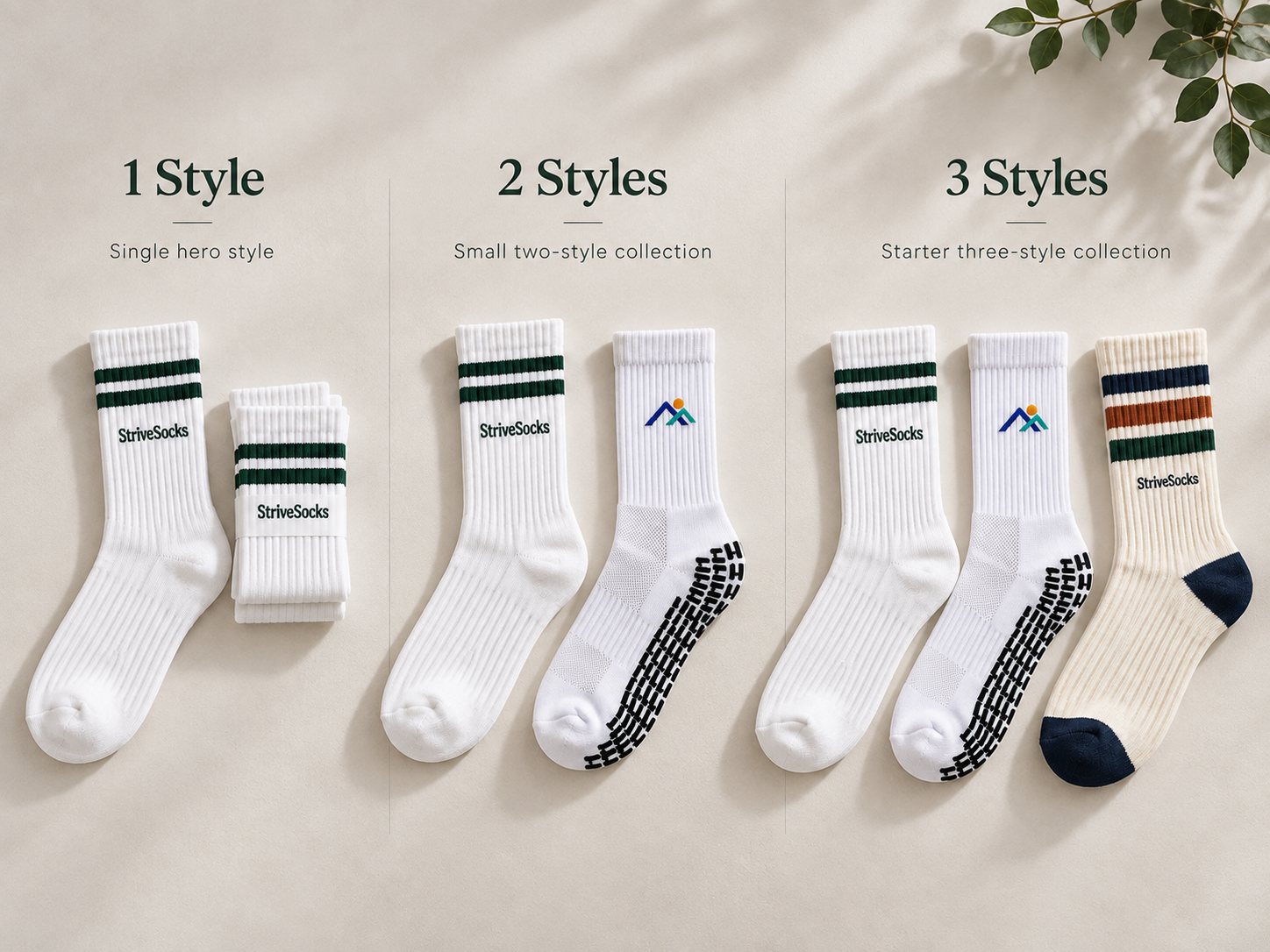
| Style Count | Primary Goal |
|---|---|
| 1 Style | Validate the product idea |
| 2 Styles | Compare two product directions |
| 3 Styles | Build a small collection |
Once you move beyond three styles, you should be confident that you can support the additional inventory, photography, marketing, packaging, stock management and reorders.
Style Count Is Only Half the Problem
Imagine you launch three styles. That still sounds small. But now add:
3 styles × 4 colors × 3 sizes = 36 SKUs
That is why color and size planning matter just as much as style count.
A new brand may be better off launching 3 styles × 2 colors × 2 sizes = 12 SKUs, or even 2 styles × 2 colors × 2 sizes = 8 SKUs.
The goal is not to minimize choice at all costs. The goal is to keep each SKU commercially meaningful.
How Many Colors Should Each Style Have?
For a new brand, two colors per style can often be enough.
Core Neutral
- Black
- White
- Cream
- Navy
Brand Color
- Orange
- Emerald
- Burgundy
- Cobalt
This allows the brand to have identity without creating too much inventory. Launching five colors of every style usually creates unnecessary complexity unless you already know those colors will sell.
Should Every Style Use the Same Colors?
Not necessarily. But there are advantages to using a shared palette.
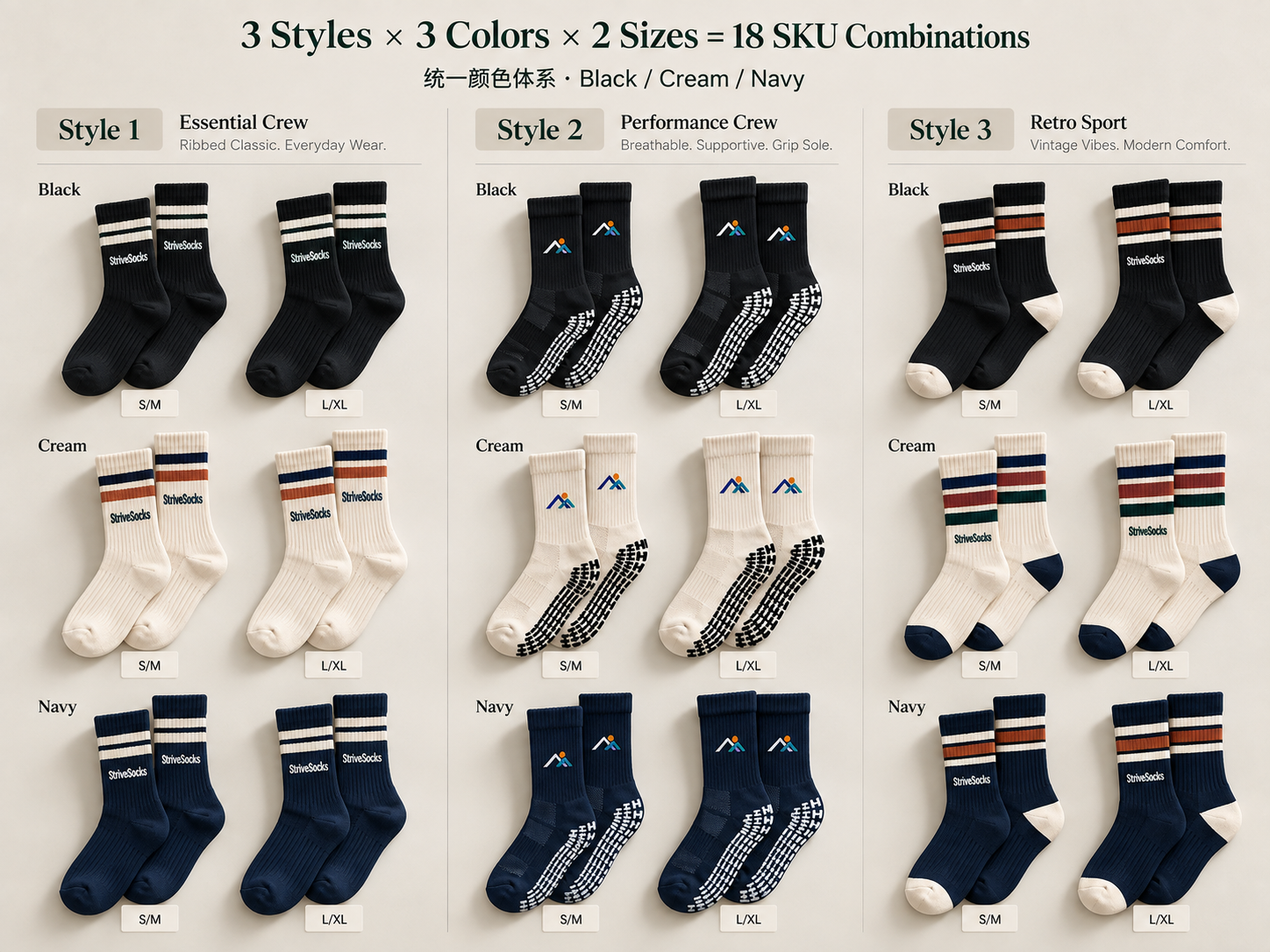
For example, a collection palette might use Black, Cream and Navy, with each style using one or two of those colors.
This creates visual consistency across the collection and simplifies product photography, website presentation, packaging and campaign styling.
For a small brand, consistency can make a compact collection feel more intentional.
How Many Sizes Should You Launch?
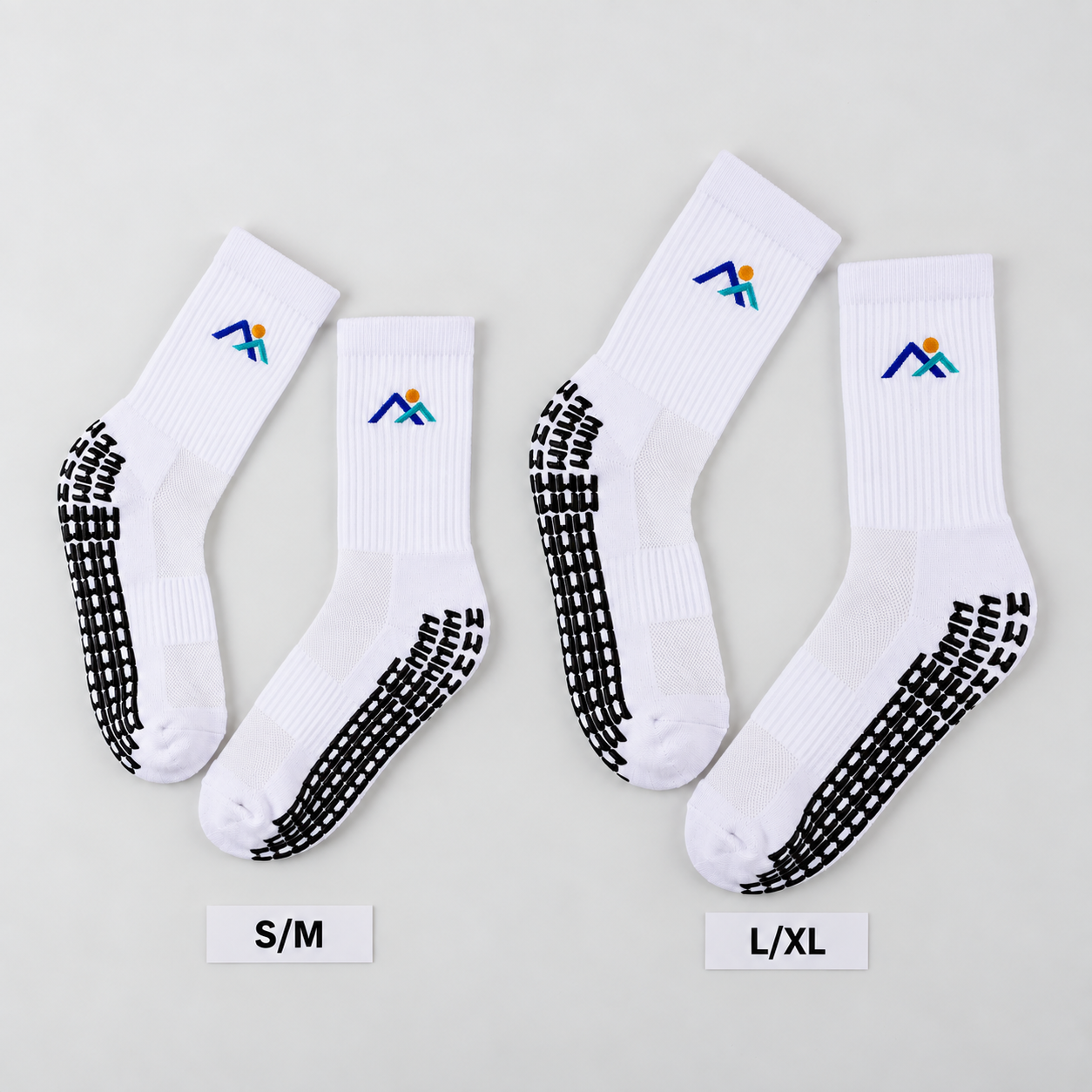
Size structure depends on the sock. Some products can use broader size ranges such as S/M and L/XL, while others may require more specific sizing.
The key is to avoid adding size complexity that the product does not need.
- Does each size have its own MOQ?
- Can sizes be mixed?
- Which size range covers most target customers?
- Can additional sizes be added later?
Size planning should be based on customer coverage, not simply on offering as many options as possible.
Example: A Focused First Lifestyle Collection
Imagine you are launching a new lifestyle sock brand.
Style 1: Essential Crew
Style 2: Retro Sport Crew
Colors: Black, Cream
Sizes: S/M, L/XL
2 styles × 2 colors × 2 sizes = 8 SKUs
If each SKU requires 50 pairs:
8 × 50 = 400 pairs
Now compare this with a larger launch:
5 styles × 4 colors × 3 sizes = 60 SKUs
At 50 pairs per SKU:
60 × 50 = 3,000 pairs
That is why style planning has a huge impact on the actual first-order commitment.
Example: A Small Performance Collection
A new performance brand may start with Performance Crew for gym and training, plus Running Quarter for running.
Colors: Black, White
Sizes: S/M, L/XL
This gives 2 × 2 × 2 = 8 SKUs.
The brand can then compare training demand, running demand, color preference and size distribution. That information can shape the second collection.
Example: A Grip Sock Brand
A Pilates or studio-focused brand could start with Low Grip Sock and Crew Grip Sock in Black and Cream.
Instead of launching low, crew, ankle, five-toe, open-toe and six colors all at once, the brand can expand after the first styles have sales history.
Do You Need Multiple Styles to Look Like a 'Real Brand'?
No. Customers do not judge a brand only by the number of products it launches.
- consistent photography
- clear product names
- strong packaging
- clear positioning
- reliable quality
- cohesive colors
A small but coherent collection often looks stronger than a large collection with no clear logic.
Collection Depth vs Collection Width
Collection Width
How many different styles you offer.
Collection Depth
How much inventory you carry in each style.
New brands often focus too heavily on width. But having too many styles can leave only a small number of units available for each SKU.
A focused collection may have less width but more useful depth. That can be better for avoiding early stock-outs, supporting marketing, collecting cleaner sales data and planning reorders.
Which Is Better: 5 Styles × 20 Pairs or 2 Styles × 50 Pairs?
It depends on the supplier's MOQ and customer demand, but conceptually, 2 stronger styles with meaningful inventory may be easier to learn from than 5 styles with very shallow stock, especially when the brand has no sales history.
The objective of a first collection is not simply to look large. It is to identify products worth repeating.
Do All Styles Need to Launch at the Same Time?
No. A staged launch can reduce risk.
| Stage | Example |
|---|---|
| Launch 1 | Essential Crew + Retro Sport |
| Launch 2 | Performance Crew after 6-8 weeks |
| Launch 3 | Seasonal color or limited edition |
This can give the brand multiple marketing moments while spreading inventory investment over time.
A Staged Collection Can Also Improve Content
Instead of launching every product at once, a brand can create separate moments for:
- new style
- new color
- seasonal drop
- restock
- new packaging
- performance upgrade
This creates more reasons to communicate with customers. One large launch is not always better than several smaller product moments.
How to Decide Which Styles Make the First Collection
Score each product idea against practical questions.
Customer Need
Does this style solve a clear customer need?
Differentiation
Is it meaningfully different from the other styles?
Manufacturing
Can it be produced reliably?
MOQ
Can you support the inventory requirement?
Retail Price
Does the expected cost fit the target retail price?
Content
Can you market it clearly?
Reorder Potential
Could this become a repeat product?
A first collection should contain the strongest answers, not simply the products the founder personally likes most.
Avoid Launching Two Styles That Are Too Similar
Suppose your first collection includes Essential Crew 01, Essential Crew 02 and Essential Crew 03 with only tiny differences.
If one sells better, you may not know why. The difference could be color, photography, stock, price or placement.
Instead, launch products with clearly different roles. That produces better learning.
Build a Hero Product First
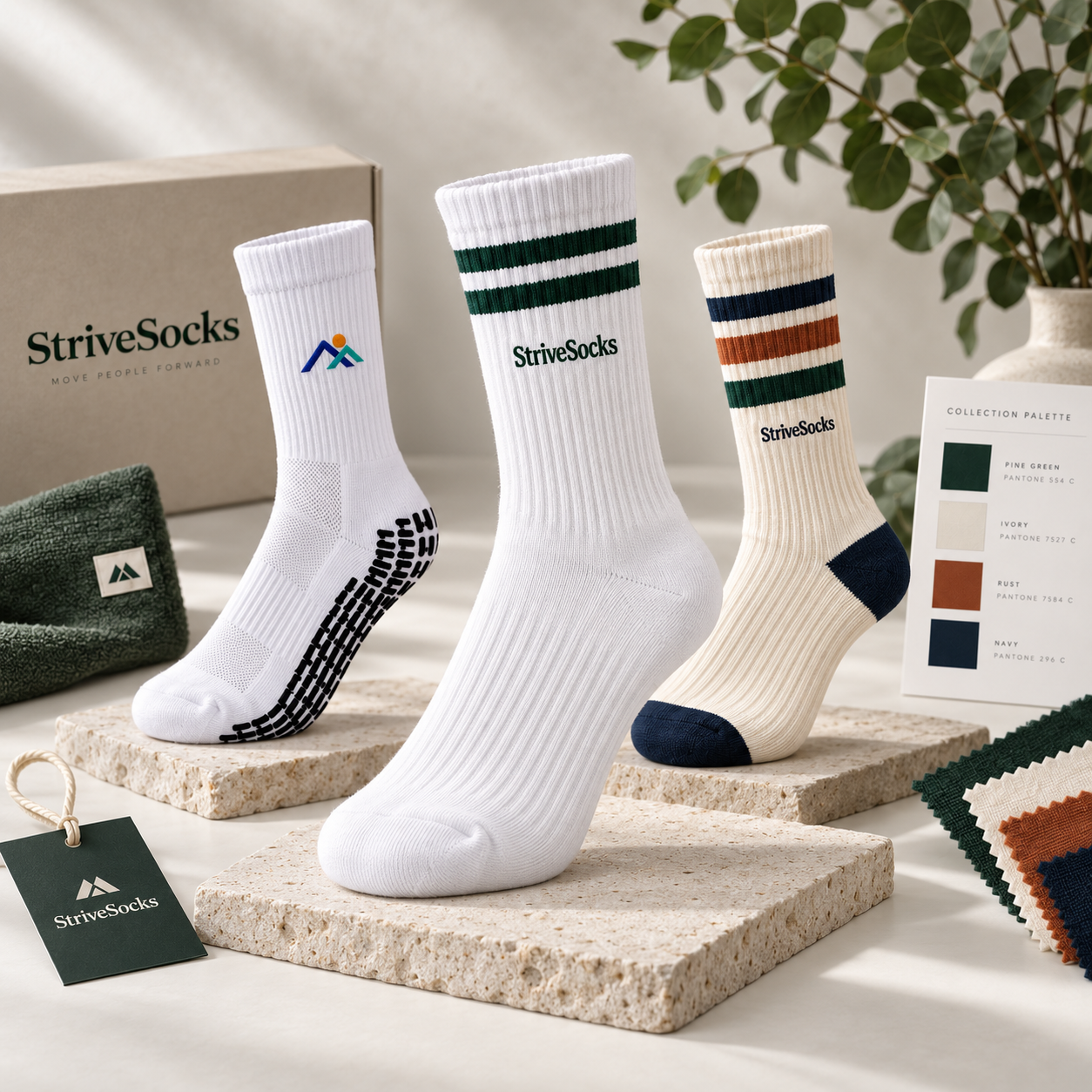
Every new collection benefits from having one main product. This is the product you expect to receive the most marketing attention, photography, homepage space, advertising and inventory.
Your other styles should support it.
| Role | Example |
|---|---|
| Hero | Performance Crew |
| Supporting Style | Running Quarter |
| Expansion Style | Retro Sport |
How Much Inventory Should Go to Each Style?
Do not automatically split inventory equally. If one product is clearly your hero style, it may deserve more stock.
For example, instead of Style A: 100 pairs, Style B: 100 pairs, Style C: 100 pairs, you might plan Hero Style: 200 pairs, Supporting Style: 100 pairs, Test Style: 50 pairs if your supplier structure allows it.
The allocation should reflect confidence and expected demand.
Keep Packaging Consistent Across Styles
A new brand does not necessarily need unique packaging for every style.
You may be able to use one packaging system across the range: the same paper band design with variable style name, size, color and barcode.
This creates brand consistency and may help reduce packaging complexity.
Product Naming Matters
When launching multiple styles, use clear naming such as:
- Essential Crew 01
- Performance Crew 01
- Running Quarter 01
- Retro Sport 01
A consistent naming system makes it easier to manage line sheets, website listings, purchase orders, photography, warehouse SKUs and reorders.
Avoid changing product names every time the marketing campaign changes.
Plan the Collection Before Sampling
Sampling should not be used to randomly explore every possible product.
Before requesting samples, decide:
- target customer
- product roles
- approximate style count
- colors
- sizes
- packaging direction
Then sample the strongest candidates. This reduces wasted development.
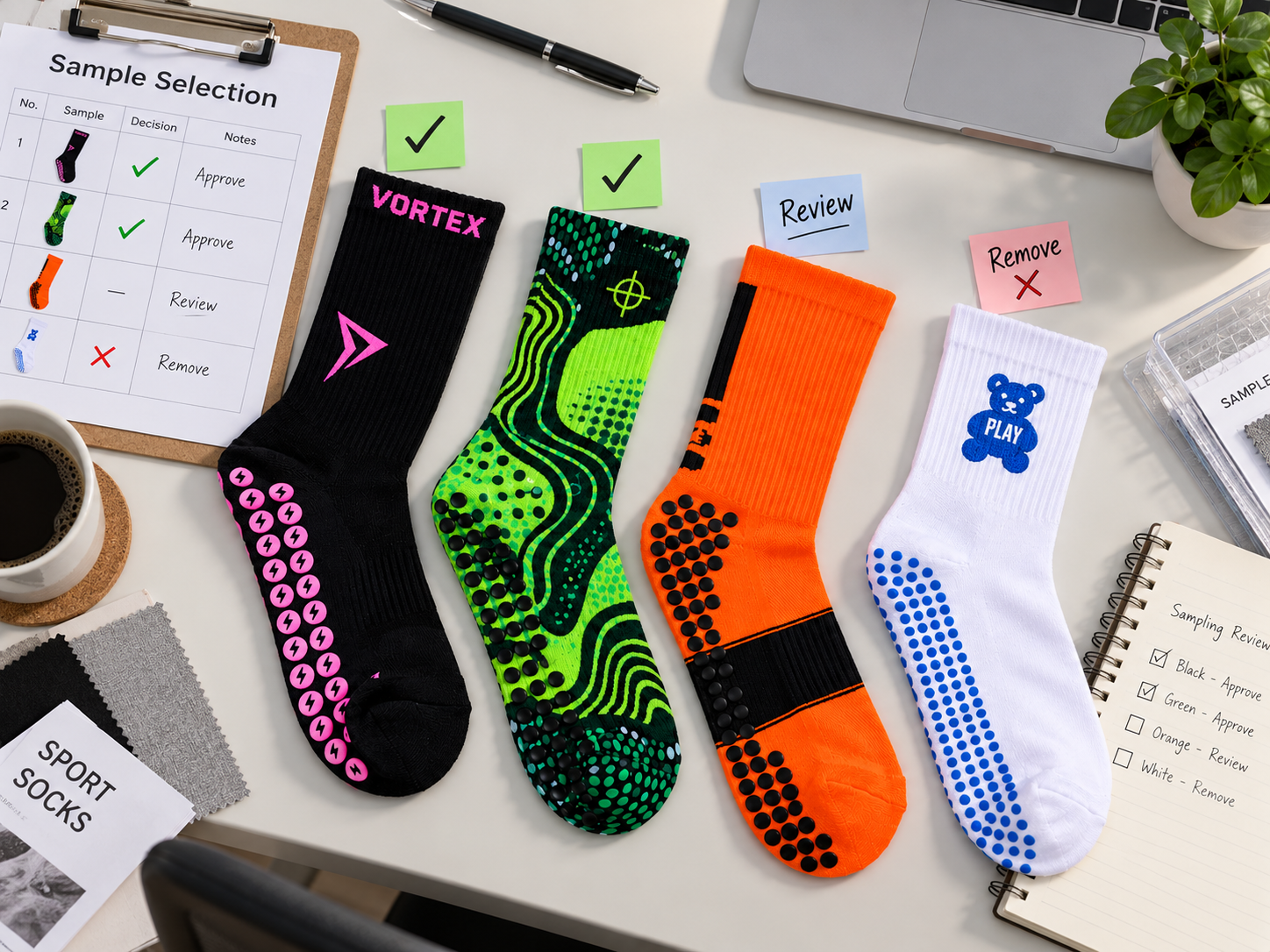
Use Samples to Remove Styles, Not Only Add Them
Sometimes the most useful result of sampling is deciding not to launch a product.
- two styles feel too similar
- one construction does not fit the brand
- one color does not look right
- one product is too expensive
- one fit is harder to manage
Removing a weak style before bulk production is a good outcome. It keeps the collection focused.
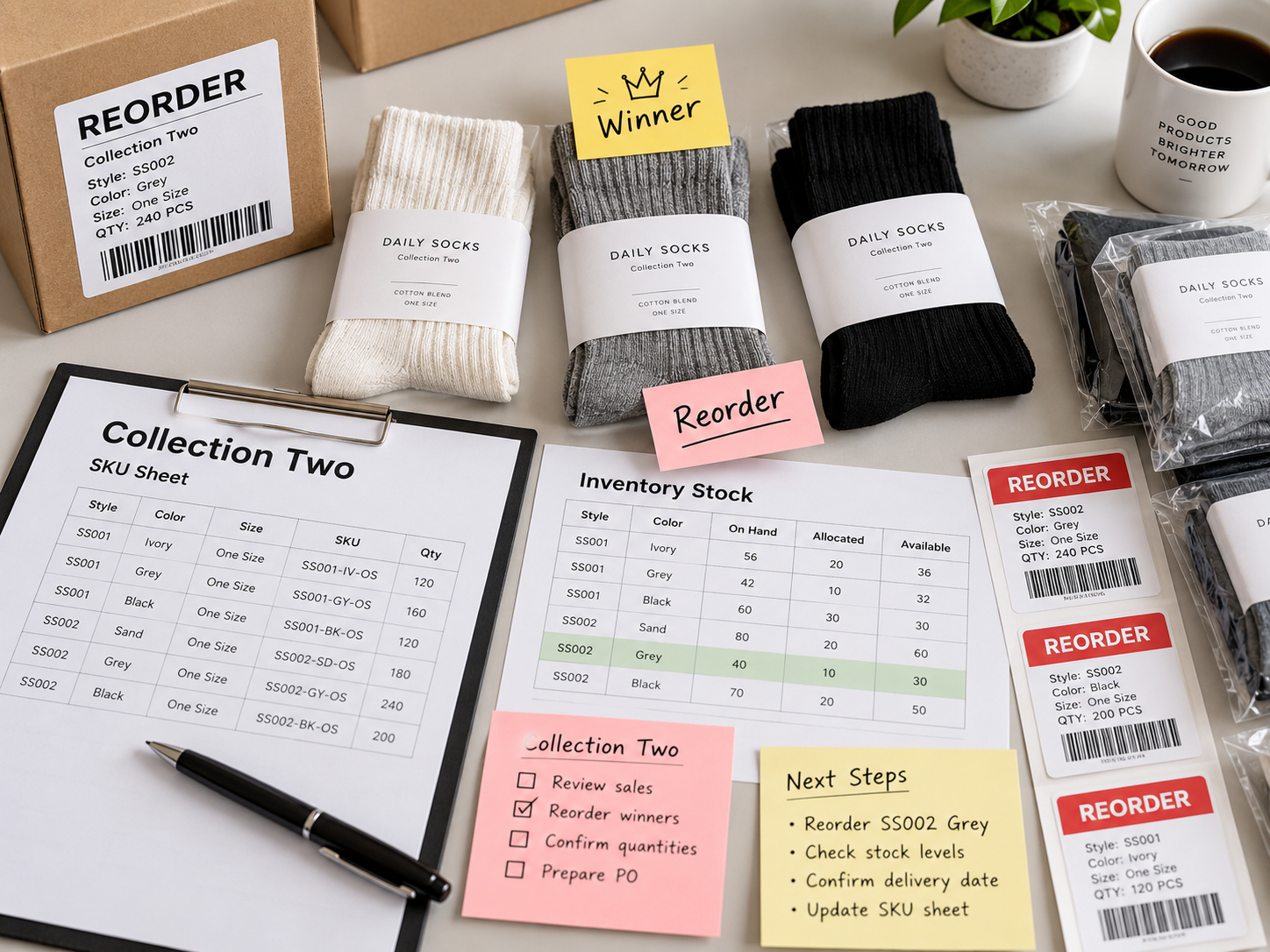
How Should Sales Data Shape Collection Two?
After launch, track each style separately.
- sales units
- conversion rate
- sell-through rate
- return rate
- size performance
- color performance
- customer feedback
- reorder demand
Winner
Increase stock or expand colors.
Stable
Keep as a core product.
Test
Continue in limited volume.
Weak Performer
Reduce or discontinue.
Collection two should be built from this information.
When Should You Add More Styles?
Add more styles when your existing collection gives you clear signals.
- hero products are selling consistently
- core sizes are predictable
- repeat orders are happening
- customers request additional styles
- inventory is turning at a healthy rate
- you understand your brand's strongest category
Expansion should follow demand, not precede it.
A Simple Growth Model
| Stage | Typical Range | Goal |
|---|---|---|
| Stage 1 - Validate | 1-2 styles | Find product-market fit |
| Stage 2 - Build the Core | 3-5 proven styles | Create a recognizable core range |
| Stage 3 - Expand | New colors, heights, seasonal products | Increase customer choice |
| Stage 4 - Scale | Exclusive/custom programs, wholesale distribution | Build a repeatable product business |
This is usually healthier than launching the final-stage assortment on day one.
Common Mistakes When Planning a First Sock Collection
Mistake 1: Too Many Styles
More styles do not automatically create more sales.
Mistake 2: Too Many Colors
Color multiplies inventory quickly.
Mistake 3: Too Many Sizes
Only add sizes that are commercially necessary.
Mistake 4: No Hero Product
Every collection should have a clear lead product.
Mistake 5: Similar Styles Competing With Each Other
Each style should serve a different purpose.
Mistake 6: Equal Inventory for Every Product
Inventory should reflect confidence and expected demand.
Mistake 7: No Reorder Plan
A collection is more useful when successful products can be replenished.
Mistake 8: Designing Before Calculating SKUs
Calculate inventory structure first.
First Collection Planning Checklist
Customer
- Who is buying?
- What use case matters most?
Styles
- How many product roles are needed?
- Is each style meaningfully different?
- Which is the hero product?
Colors
- Are one or two colors enough to start?
- Is there one core neutral?
- Is there one brand color?
Sizes
- What size ranges are truly needed?
- How does MOQ apply to size?
Inventory
- How many total SKUs?
- How much stock per SKU?
- Can you reorder quickly?
Branding
- Is the collection visually consistent?
- Can packaging work across multiple styles?
Commercial
- Does each product fit the intended retail price?
- Can you support photography and marketing for every style?
If the answers are unclear, the collection may be too large.
FAQ: How Many Sock Styles Should a New Brand Launch With?
Is one sock style enough for a new brand?
Yes. If the product solves one clear need and has a strong identity, a one-style launch can be a good way to validate demand.
Is three sock styles too many for a first collection?
Not necessarily. Three distinct styles can create a useful small collection, provided the total number of colors, sizes and SKUs remains manageable.
How many colors should each sock style have?
For many new brands, one or two colors per style are enough to begin testing demand. More colors can be added after sales patterns become clearer.
Should all sock styles have the same colors?
They do not have to, but a shared color palette can make the collection feel more cohesive and simplify photography and merchandising.
How many SKUs should a new sock brand launch?
There is no universal number. The more useful metric is whether you can carry enough inventory in each SKU and manage the collection effectively. A smaller SKU count usually makes early-stage testing easier.
Should I launch several styles at once or release them gradually?
Both can work. A staged launch may reduce inventory risk and create more marketing opportunities over time.
What type of sock should be the hero product?
Choose the product that best represents the brand's target customer, positioning and strongest commercial opportunity. It should be the style you are most confident can become a repeat seller.
When should I add a new sock style?
Add styles after you have useful sales data or a clear customer need that the current collection does not address. Expansion should support demand rather than simply increase product count.
Start With Enough Choice - Not Too Much Choice
A new brand does not need a large collection to look credible. It needs a collection that makes sense.
For many first launches, that may mean 1-3 distinct sock styles with 1-2 core colors and a controlled size range.
The goal is to keep enough inventory behind each product to learn what customers actually want.
- Reorder the winners.
- Remove weak products.
- Add colors where demand exists.
- Develop new styles when the market gives you a reason.
That is how a small first collection can become a scalable product range.
Build Your First Sock Collection
If you are planning a new collection, define:
- Target customer
- Hero sock style
- Supporting styles
- Colors
- Sizes
- Expected quantity
- Packaging
- Target launch date
Then review the total SKU count before moving into sampling.
Choose a focused product direction: compare private label athletic socks with private label crew socks before expanding the number of styles.
← Back to Blog