 STRIVESOCK
Starting a sock brand does not require launching ten styles, six colors and hundreds of units on day one.
In fact, for many new brands, that approach creates more problems than opportunities.
A better first launch is often smaller and more focused.
The goal is not to build the biggest collection possible. The goal is to answer a few important questions:
- Which sock style do customers actually want?
- Which colors sell?
- What price point works?
- Which sizes move fastest?
- Does the packaging feel right?
- Can the product be reordered consistently?
A small first order can help you learn those answers without committing too much cash to inventory. This guide explains how to start a sock brand with a more controlled first production run.
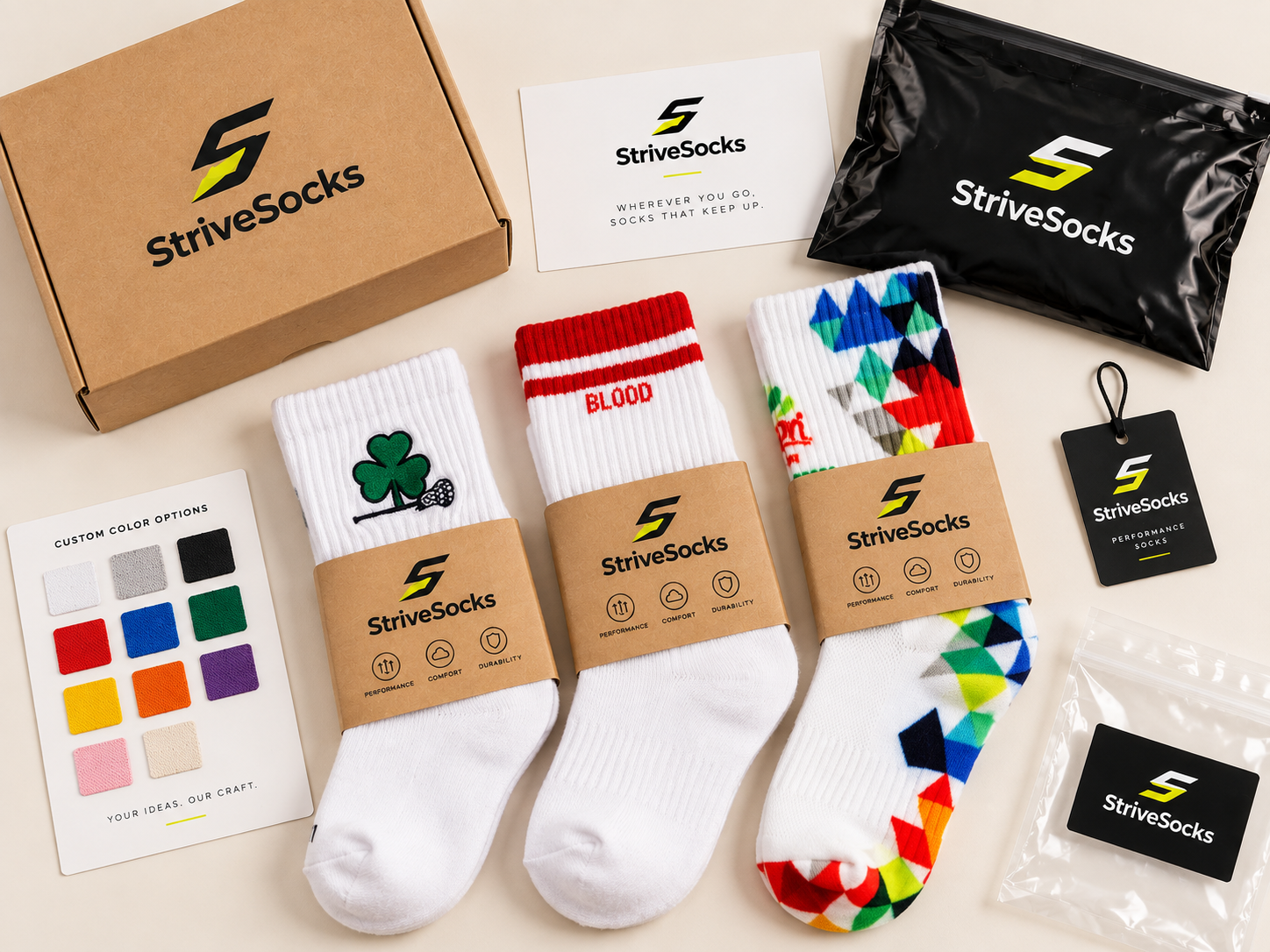
Quick Answer: Can You Start a Sock Brand With a Small Order?
Yes. A small first order can be a practical way to launch a new sock brand if you keep the product range focused.
For some private label sock programs, starting quantities may be around 50 pairs per style / color / size combination, depending on the product and level of customization.
But the real challenge is not simply finding the lowest MOQ. It is designing the first collection so the MOQ remains manageable.
1 style × 2 colors × 1 size = 2 SKUs
3 styles × 4 colors × 3 sizes = 36 SKUs
The second collection may look more impressive, but it requires far more inventory. For a new brand, simplicity can be an advantage.
Why Starting Small Can Make Sense
A first production order is different from a repeat order. When you launch a new sock product, you are still learning.
- which style will sell fastest
- which color customers prefer
- whether your fit is correct
- whether packaging needs adjustment
- whether your retail price feels right
- how frequently customers will reorder
Large inventory does not solve these uncertainties. It only increases the amount of money committed before you have the answers.
A smaller launch allows you to collect real customer data first. Then future orders can be based on demand rather than assumptions.
Step 1: Decide Who the Sock Is For
Before choosing yarn, colors or packaging, define the customer. A sock brand becomes difficult to position when the answer is: “Anyone who wears socks.”
Instead, decide whether your first product is mainly for:
- lifestyle customers
- runners
- gym users
- football players
- Pilates customers
- streetwear buyers
- retailers
- gift buyers
This decision affects almost everything else.
Lifestyle Sock Priorities
- color
- design
- comfort
- styling
Running Sock Priorities
- breathability
- cushioning
- arch support
- moisture management
Grip Sock Priorities
- grip coverage
- fit
- stretch
- stability
Your first product should solve one clear use case.
Step 2: Start With One Strong Product Direction
One of the most common mistakes new brands make is launching too many products at once.
You may be tempted to begin with crew socks, ankle socks, running socks, grip socks, compression socks and no-show socks. But every additional style creates more decisions.
- separate sampling
- separate sizing
- separate colors
- separate photography
- separate packaging
- separate ecommerce listings
- separate inventory planning
For a first launch, one strong product direction is often enough.
Lifestyle Brand
Start with one crew sock.
Activewear Brand
Start with one performance crew or running sock.
Pilates Brand
Start with one grip sock.
Retail Brand
Start with one proven everyday style.
You can expand later.
Step 3: Use a Proven Base Style When Possible
A new brand does not always need to develop a sock completely from scratch. A private label model allows you to start with an existing, proven construction and customize the elements customers see.
- logo
- colors
- stripes
- graphics
- labels
- packaging
This can reduce the number of technical decisions required during the first launch.
For example, instead of creating a new crew sock construction, you might choose an existing base and customize: Cream body + navy stripe + side logo + branded paper band.
That gives you a branded product without unnecessary development complexity. For early-stage brands, this is often more practical than full product development.
Step 4: Keep the First Collection Small
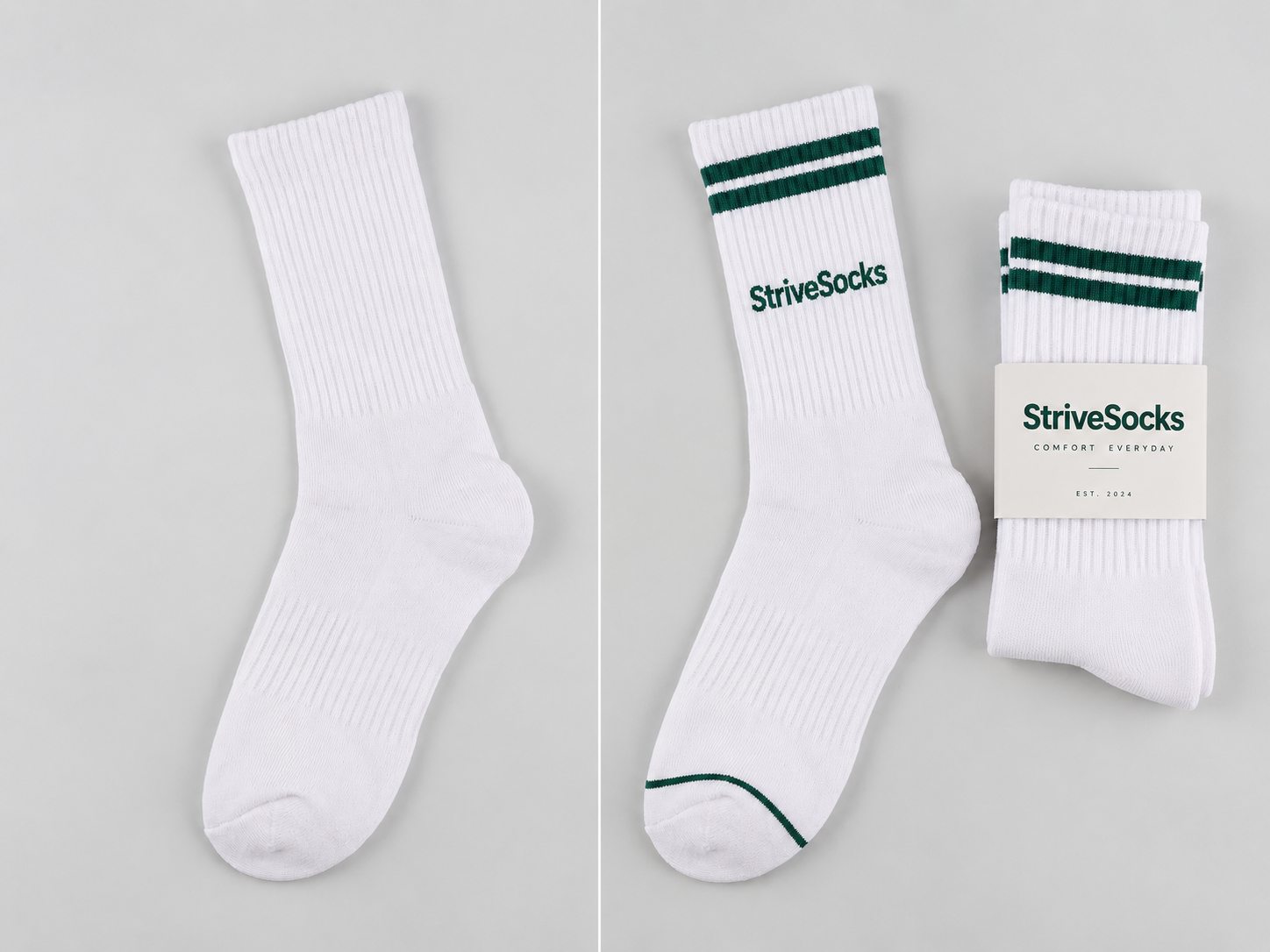
Option A — One Style, Two Colors
- 1 sock style
- Black
- Cream
This creates two main product options.
Option B — Two Styles, Two Colors
- Essential Crew
- Retro Crew
- Black
- Cream
This creates four product directions.
Option C — One Performance Style
- 1 technical sock
- 2 sizes
- 1–2 colors
This keeps the launch focused while still serving size requirements. The exact combination depends on how the supplier calculates MOQ.
Do not multiply styles, colors and sizes without calculating the total number of SKUs first.
Step 5: Understand Your MOQ Before Designing the Collection
MOQ means Minimum Order Quantity. But new buyers often misunderstand what that number applies to.
A supplier may calculate MOQ by:
- style
- color
- size
- design
- packaging option
For example, if the MOQ is 50 pairs per style / color / size, then:
| Style | Color | Size | Quantity |
|---|---|---|---|
| Crew | Black | S/M | 50 |
| Crew | Black | L/XL | 50 |
| Crew | Cream | S/M | 50 |
| Crew | Cream | L/XL | 50 |
Total: 200 pairs
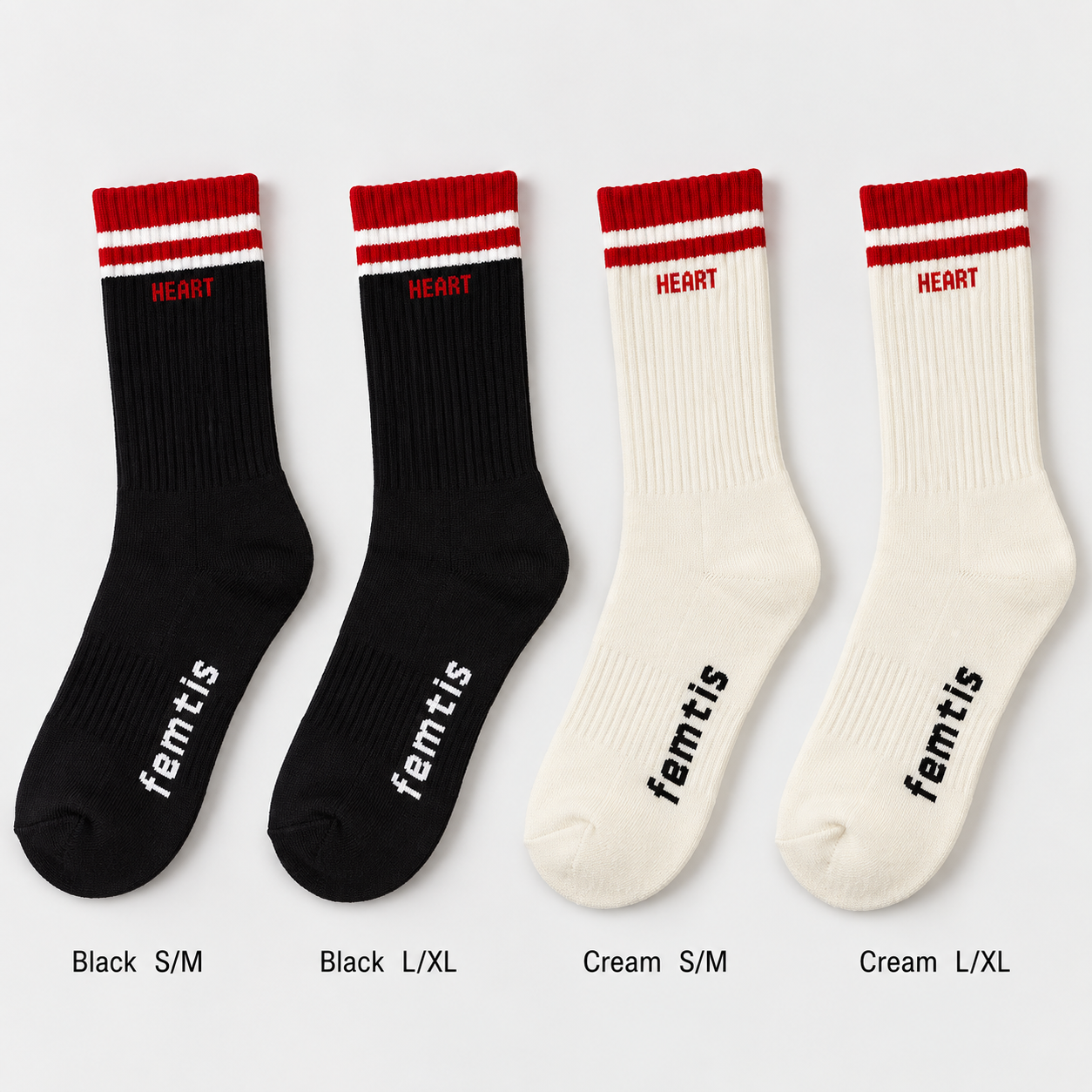
This is why MOQ planning should happen before finalizing the collection. A small headline MOQ can still become a large total order when too many combinations are added.
Step 6: Choose Core Colors First
Color is one of the easiest ways to increase inventory. New brands often want to launch many colors because each option looks attractive during product development.
A safer first approach is to choose:
One Core Neutral
- Black
- Cream
- White
- Navy
One Brand Color
- Emerald
- Orange
- Burgundy
- Cobalt
This gives the collection personality without creating too many SKUs. After launch, sales data can determine which additional colors deserve production.
Step 7: Keep Size Planning Practical
Sizing matters, but too many sizes can also increase the first-order quantity. The right size structure depends on the product.
Before production, ask:
- Can sizes be mixed within MOQ?
- Does every size require a separate minimum?
- Which size range covers the largest share of my target customer?
- Can additional sizes be added later?
A new brand should avoid creating more size complexity than the product actually requires.
Step 8: Build the Product Around Your Target Price
Do not develop the product first and think about retail price later. Work backwards.
What retail price makes sense for my customer?
Then consider:
- product cost
- packaging
- freight
- duties
- transaction fees
- fulfillment
- retail margin
- marketing cost
A sock designed to retail as an affordable everyday product should not be overbuilt with features the customer may not value. Likewise, a premium technical sock needs enough product value to justify a higher retail price.
The product specification and retail positioning should support each other.
Step 9: Keep Branding Simple at the Beginning
A strong brand does not require every part of the sock to be customized. For the first order, focus on the areas customers actually notice.
- logo
- core colors
- one recognizable design detail
- packaging
For example, Logo + signature stripe + branded band may create a clearer product identity than adding five different decorative details.
Simple designs are also easier to sample, approve, reproduce and reorder. Consistency matters more than complexity.
Step 10: Do Not Overbuild the Packaging
Packaging is important, but it can also consume a surprising amount of the first-order budget.
A new brand may want rigid boxes, custom inserts, printed tissue, stickers, cards and premium bags before the product has sold a single pair.
In many cases, a simpler retail-ready system is enough.
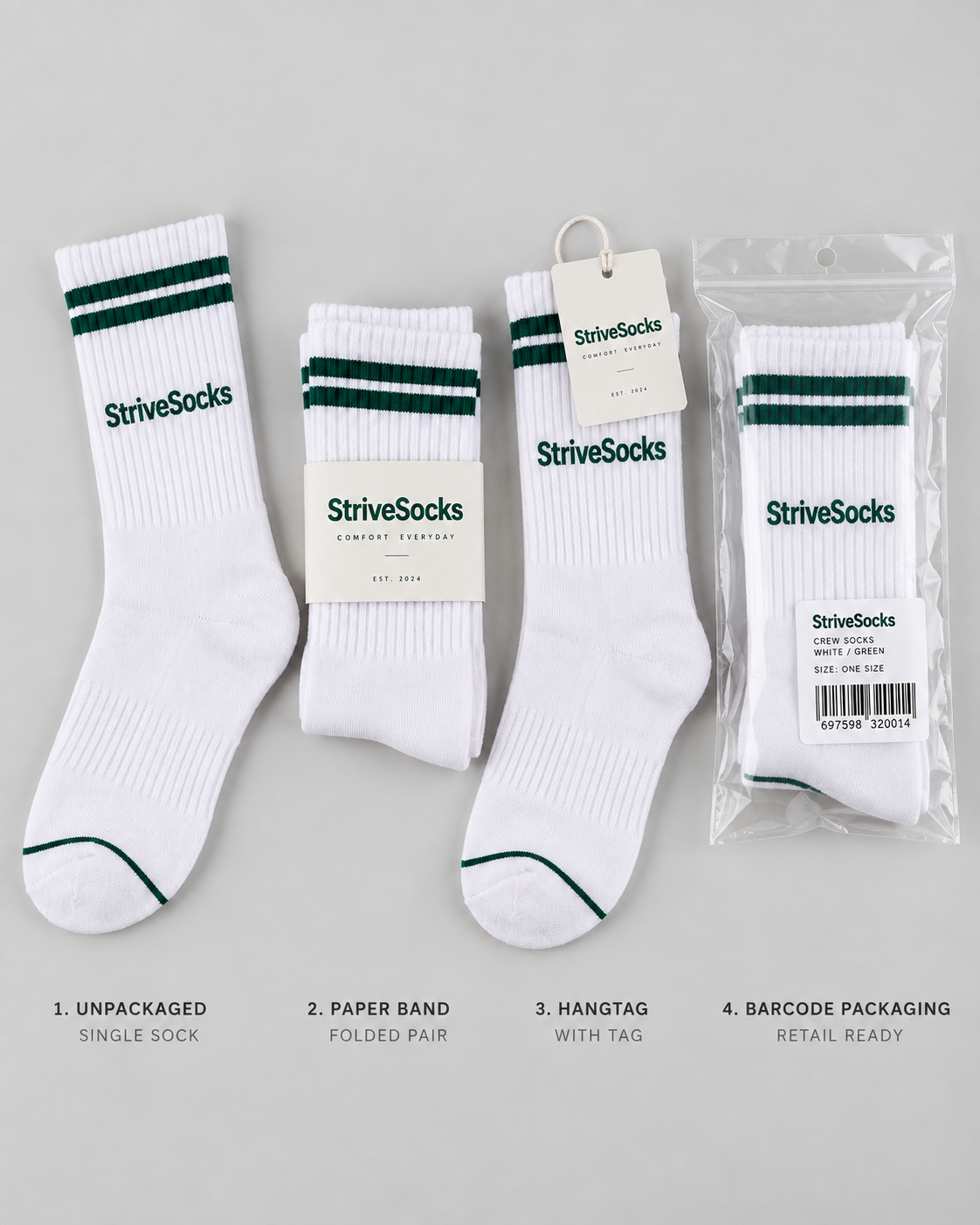
Simple First Launch
Sock + branded paper band + barcode, or Sock + custom hangtag + size label.
This can still look professional while keeping cost and packaging MOQ manageable. You can upgrade packaging once the product has proven demand.
Step 11: Order Samples Before Bulk Production
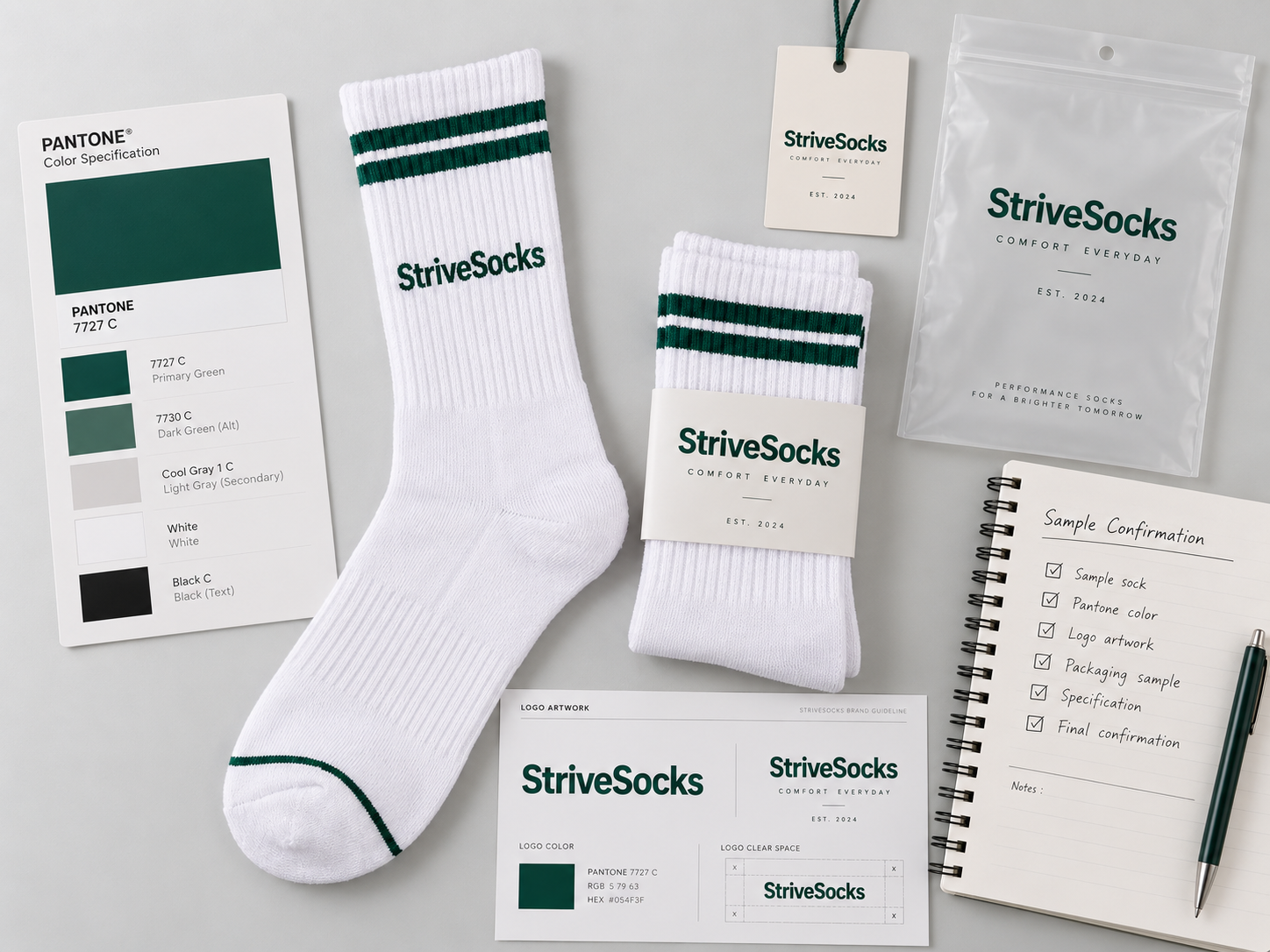
A digital mockup is not enough. Before approving bulk production, evaluate a physical sample.
- overall shape
- sock length
- size
- fit
- yarn feel
- thickness
- elasticity
- logo position
- logo clarity
- colors
- grip
- heel
- toe
- packaging
Wear the sample. Wash it. Compare it against your intended retail positioning.
A small brand cannot afford to discover product problems after the inventory has already arrived. Sampling reduces that risk.
What Should You Check on a Sock Sample?
1. Fit
- foot length
- cuff tension
- heel placement
- toe fit
2. Comfort
- uncomfortable seams
- excessive compression
- loose areas
- rough yarn
- excessive thickness
3. Visual Quality
- logo alignment
- stripe position
- color consistency
- knitted graphics
- finishing
4. Function
- grip
- cushioning
- arch support
- breathability
- stretch
5. Packaging
- brand name
- barcode
- size
- color name
- product information
- positioning of labels
Create a written approval record before production.
Step 12: Know Your Real First-Order Cost
Do not calculate your budget using only the sock unit price. Your real first-order cost may include:
Product cost + Sample development + Logo / artwork setup + Grip mold if required + Packaging + Freight + Import costs
This gives you a much better picture of your actual investment and helps you calculate the real landed cost per pair.
Step 13: Calculate Inventory Before Ordering
Before placing the order, create a simple SKU table.
| SKU | Style | Color | Size | Qty |
|---|---|---|---|---|
| CR-BLK-SM | Crew | Black | S/M | 50 |
| CR-BLK-LX | Crew | Black | L/XL | 50 |
| CR-CRM-SM | Crew | Cream | S/M | 50 |
| CR-CRM-LX | Crew | Cream | L/XL | 50 |
Then calculate total units, total production cost, packaging cost, freight and landed cost per SKU. This prevents surprises after quotation.
Step 14: Think About Photography Before Production
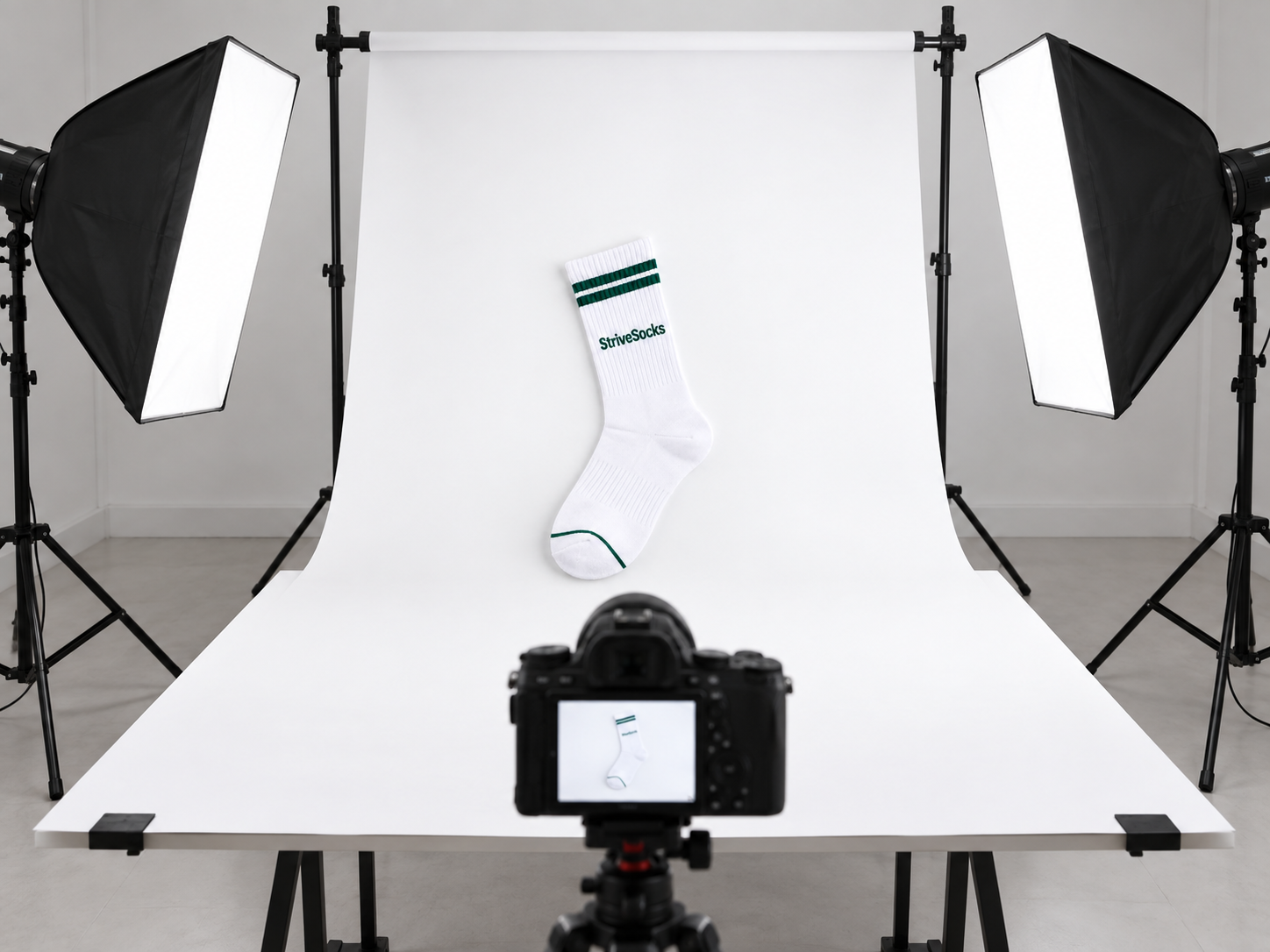
New brands often leave photography until the product arrives. But the visual direction should be planned earlier.
- ecommerce product images
- close-up details
- lifestyle imagery
- packaging photos
- social media
- launch campaign
If you know what photography is needed, you can make sure the production sample is suitable for content creation before bulk inventory arrives. This can reduce launch delays.
Step 15: Build a Simple Launch, Not a Huge Launch
A first launch does not need 20 products, multiple collections, large advertising budgets or complex retail packaging. You need enough to test the product.
Product Range
2–4 SKUs
Ecommerce
1 product page per style
Content
- hero product photo
- detail photos
- packaging photo
- fit or lifestyle image
Marketing
- social content
- small paid test
- existing audience
The goal is to learn.
Step 16: Track What Customers Actually Buy
After launch, measure product behavior. Do not rely only on comments or likes.
- units sold
- conversion rate
- color performance
- size performance
- return rate
- repeat purchase
- customer questions
- stock-out speed
This information determines the second order. If Black sells twice as fast as Cream, your next production order does not need to remain 50/50. Adjust based on real sales.
Step 17: Reorder Before You Run Out
A successful first launch can create another problem: running out of stock too early.
Before launching, ask your supplier:
- What is the repeat-order MOQ?
- What is the production lead time?
- Can the same yarn colors be reproduced?
- Is the packaging specification stored?
- Can the approved logo setup be reused?
Then determine your reorder point. If the reorder lead time is several weeks, do not wait until inventory reaches zero.
A good sock brand is not built only by launching products. It is built by keeping successful products available.
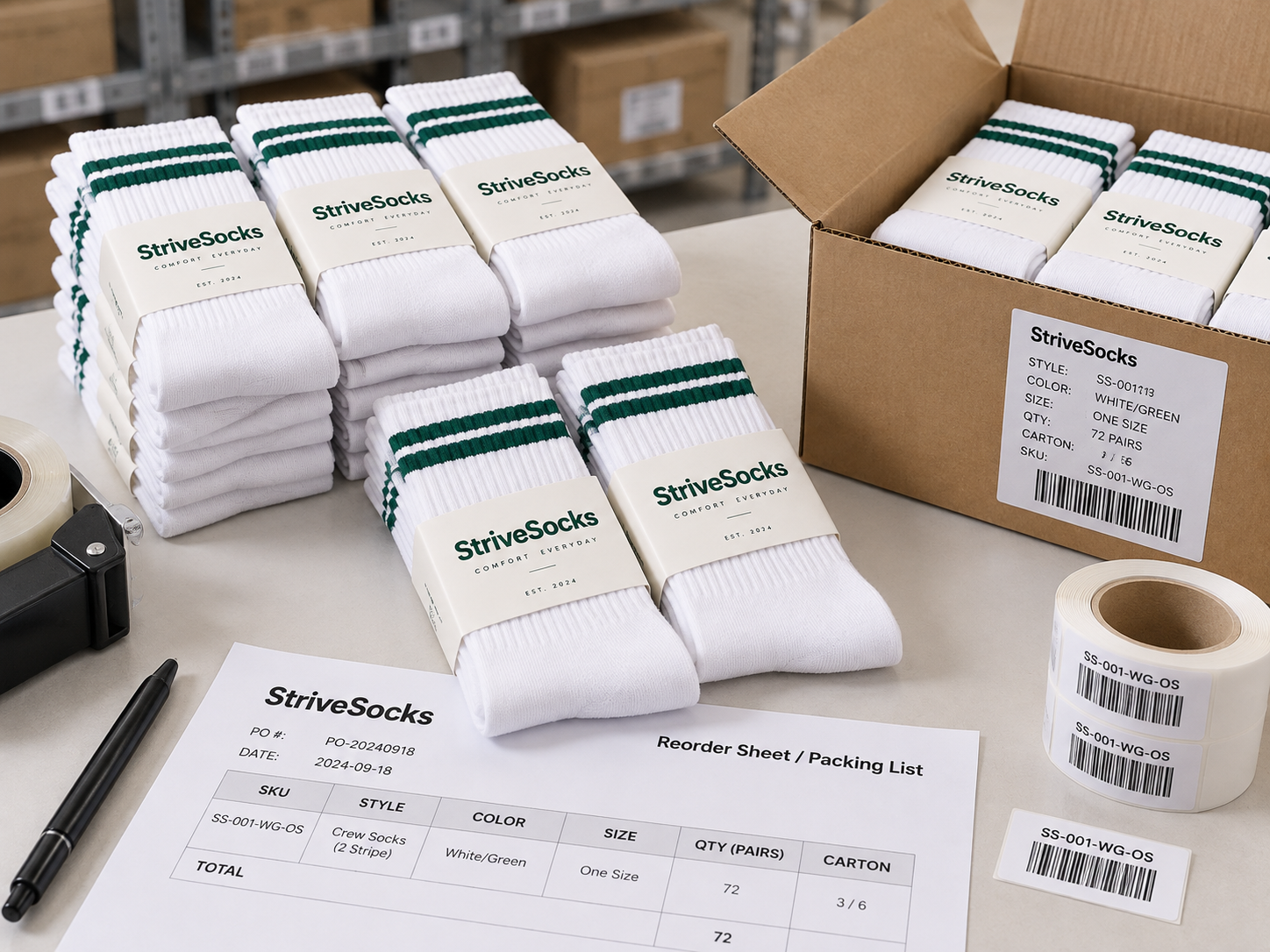
A Simple First-Order Example
Imagine you are launching a lifestyle sock brand. Instead of launching 5 styles × 5 colors × 3 sizes = 75 SKUs, you start with:
Style
Essential Crew
Colors
- Black
- Cream
Sizes
- S/M
- L/XL
Branding
Knitted side logo
Packaging
Branded paper band
This creates 4 SKUs. If each configuration requires 50 pairs: 4 × 50 = 200 pairs total.
Now your first launch is much easier to photograph, list online, warehouse, analyze and reorder. If Cream S/M performs poorly but Black L/XL sells quickly, you have useful information for your next production run.
Another Example: Starting a Grip Sock Brand
Suppose you want to start a Pilates grip sock brand. A complicated launch might include ankle, crew, open toe, full toe, five colors and custom grip patterns.
Instead, the first collection could be:
- One proven crew grip sock
- Two colors: Black and Cream
- One standard grip layout
- One custom upper logo
- One simple branded band
This reduces initial development. Later, once the brand learns what sells, it can add custom outsole grip, new colors, an ankle version and seasonal products.
Test → Learn → Reorder → Expand
Wholesale or Private Label for Your First Order?
Wholesale
Choose existing products. Best when your priority is fast launch, testing demand and low development complexity.
Private Label
Choose a proven base and customize the brand-facing elements. Best when your priority is your own logo, brand consistency, custom colors and retail presentation.
A new brand does not automatically need full custom development. Start with the simplest buying model that still supports your positioning.
When Should You Use Fully Custom Development?
Fully custom development becomes useful when an existing base style cannot meet the product requirement.
- proprietary structure
- unique fit
- exclusive cushioning
- special yarn blend
- new compression zones
- custom technical construction
This can be valuable later. But it may create unnecessary complexity for a first product if the market has not yet been validated.
How Much Money Should You Budget?
There is no universal startup budget. The total depends on product type, quantity, number of SKUs, sampling, logo method, packaging, shipping, photography, ecommerce and marketing.
The best approach is to separate your budget into:
Product Development
Samples and setup.
Inventory
Bulk production.
Packaging
Bands, tags, boxes and labels.
Logistics
Shipping and import.
Launch
Photography, website and marketing.
Do not spend the entire budget on inventory. A product still needs to be presented, launched and sold.
Common Mistakes New Sock Brands Make
Mistake 1: Launching Too Many Styles
More styles create more inventory and less clear sales data.
Mistake 2: Choosing Too Many Colors
Every color increases SKU complexity.
Mistake 3: Focusing Only on Unit Price
A cheaper product does not automatically create a healthier business.
Mistake 4: Skipping Samples
Bulk production should not be the first time you physically evaluate the product.
Mistake 5: Spending Too Much on Packaging
Start retail-ready. Upgrade later.
Mistake 6: Ignoring Reorder Lead Time
Selling out is good only if you can restock.
Mistake 7: Developing Everything From Scratch
Use proven product bases when they already meet your needs.
Mistake 8: Ordering Based on Personal Preference
Your favorite color is not automatically your customer’s favorite color. Use sales data.
First Sock Collection Checklist
Product
- Clear target customer
- One main use case
- Proven base or defined construction
Range
- Limited styles
- Limited colors
- Practical size range
- Manageable SKU count
Branding
- Final logo
- Logo position
- Color references
- Brand packaging
Sample
- Fit approved
- Construction approved
- Logo approved
- Color approved
- Packaging approved
Commercial
- MOQ confirmed
- Unit price confirmed
- Packaging cost confirmed
- Shipping estimate confirmed
- Landed cost calculated
Reorder
- Repeat MOQ understood
- Lead time understood
- Specification saved
- Reorder plan prepared
If these areas are clear, the first production order becomes much easier to manage.
FAQ: Starting a Sock Brand With a Small Order
How many socks should I order for my first launch?
There is no single number that fits every brand. The total depends on the supplier’s MOQ and how many styles, colors and sizes you launch. The most important goal is keeping your first SKU count manageable.
Can I start a sock brand with 50 pairs?
Some private label programs may support approximately 50 pairs per style, color and size combination. However, 50 pairs does not necessarily mean 50 pairs across an entire multi-color collection. Always confirm how the MOQ is calculated.
How many styles should a new sock brand start with?
For many new brands, one to three strong styles can be enough for an initial launch. The right number depends on the customer, sales channel and available inventory budget.
Should I start with custom socks or private label socks?
If a proven sock construction already fits your product needs, private label may provide a simpler starting point. Fully custom development is more appropriate when you need unique construction or technical features.
Should I order samples first?
Yes. Physical samples allow you to evaluate fit, materials, logo execution, colors, grip and packaging before bulk production.
How many colors should I launch?
A focused first launch often works better with one or two core colors. Additional colors can be added after you understand customer demand.
Do I need custom packaging?
Not necessarily. A branded paper band or hangtag may provide enough retail presentation for an early-stage launch. More complex packaging can be added later.
What should I send a sock supplier for a quotation?
Prepare a reference product, quantity, colors, sizes, logo, preferred branding, packaging requirement and shipping destination. The clearer your brief, the more accurate the quotation can be.
Start Small. Build Around What Sells.
Starting small does not mean thinking small. It means using your first production order to learn.
Instead of committing a large budget to assumptions, build a focused product range that can answer real commercial questions.
Start with: 1–3 strong products
Keep: colors and SKUs controlled
Evaluate: physical samples
Launch: a simple, clear collection
Then: reorder the winners and expand from real demand
That creates a more sustainable path from first order to long-term product range.
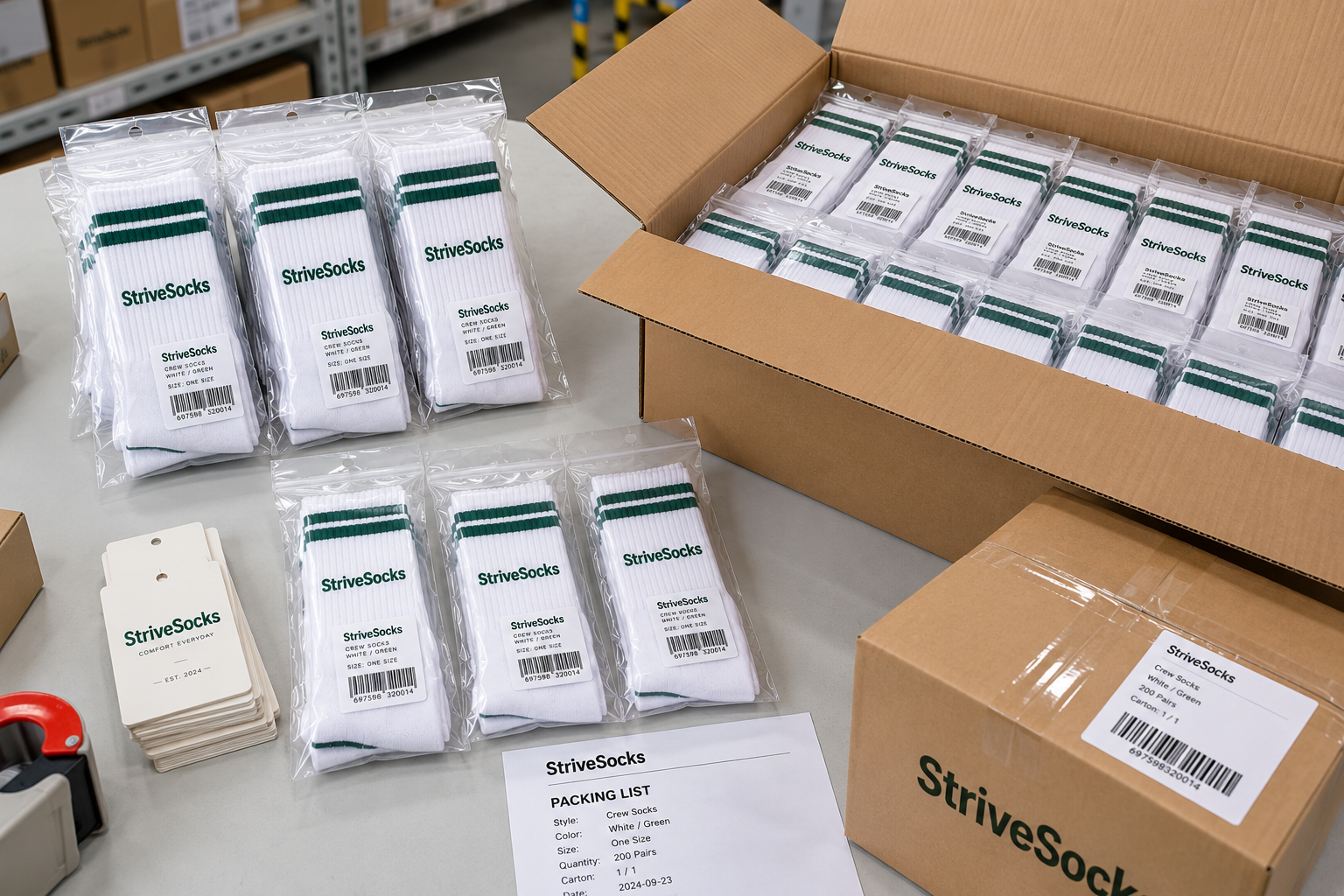
Ready to Build Your First Sock Collection?
If you already have a brand idea, logo or product reference, start by defining:
- Sock style
- Target customer
- Quantity
- Colors
- Sizes
- Branding
- Packaging
- Destination
Then we can review whether Wholesale, Private Label or Fully Custom is the most practical route.
Keep the first order focused: review the low MOQ private label socks program and begin with a clear category such as private label crew socks.
← Back to Blog